
Rahul, a 26-year-old customer service executive at a private bank in Pune, had been dreaming of cracking the IBPS PO exam for two years. But every time he sat down to study after a nine-hour shift, exhaustion would win. Sound familiar?
If you are someone who is trying to prepare for IBPS PO while working full-time, you already know the biggest challenge is not intelligence or hard work — it is time management and mental stamina. The IBPS Probationary Officer exam is one of the most sought-after competitive exams in India, attracting over 10 lakh applicants every year for a few thousand seats. The competition is fierce, and attempting it alongside a 9-to-5 job makes it exponentially harder.
But here is the good news: it is absolutely possible. Thousands of working professionals crack IBPS PO every year. This guide is designed specifically for people like you — the ones who do not have the luxury of preparing full-time, but are determined enough to make it work anyway.
In this detailed guide, you will find a realistic preparation strategy, time management tactics, subject-wise tips, sample weekly schedules, and real-life examples that will help you prepare for IBPS PO while working full-time — without burning out.
1. Understanding the IBPS PO Exam: What You Are Actually Preparing For
Before diving into strategy, it is important to understand exactly what the IBPS PO exam demands of you. Many working aspirants make the mistake of diving into random YouTube lectures without having a clear picture of the exam pattern.
The IBPS PO selection process happens in three phases:
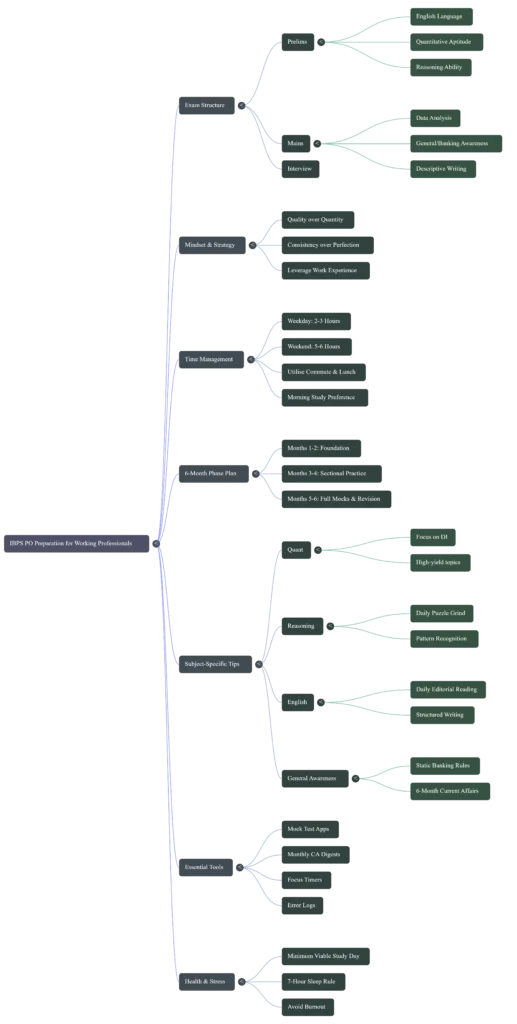
- Prelims — 100 marks, 1 hour (English Language, Quantitative Aptitude, Reasoning Ability)
- Mains — 200 marks + 25-mark Descriptive (Data Analysis & Interpretation, Reasoning & Computer Aptitude, General/Economy/Banking Awareness, English Language, and a Letter/Essay writing section)
- Interview — 100 marks (personality test conducted by member banks)
The final selection is based on Mains + Interview combined score. This means you need to be strong in analytics, language, current affairs, and communication — a well-rounded preparation is non-negotiable.
💡 Reality Check: The IBPS PO Prelims cutoff typically hovers between 55–65 marks out of 100 (varies by category and year). For Mains, the sectional and overall cutoffs are stricter. Knowing this helps you set realistic daily study targets.
2. The Mindset Shift That Changes Everything
Here is what most coaching articles will not tell you: preparing for IBPS PO while working full-time is 30% strategy and 70% mindset.
Priya, a 28-year-old software tester in Bengaluru, cleared IBPS PO on her second attempt. When asked what changed the second time, she said: “I stopped comparing myself to fresh graduates who could study 10 hours a day. I accepted that my 3 hours of focused preparation were my best, and I made every minute count.”
Here are the three mindset shifts you must make:
2.1 Quality Over Quantity
Studying 8 hours on a weekend with a distracted mind is less effective than 2 hours of laser-focused study on a Tuesday night. Working professionals often compensate for the lack of hours by cramming on weekends — this is a trap. Your goal is to build consistency, not occasional bursts.
2.2 Progress Over Perfection
You will miss study sessions. You will have weeks where work deadlines eat into your prep time. That is fine. Do not let guilt push you into abandoning your schedule entirely. A skipped day is recoverable; a skipped month is not.
2.3 You Have an Advantage
Yes, you read that right. Working professionals preparing for IBPS PO have one unique advantage: real-world understanding of banking and financial concepts. When topics like NPA, CRR, SLR, or monetary policy appear in the General Awareness section, you are not reading them as an outsider. This lived context can be a significant edge in both Mains and the interview.
3. How Much Time Do You Actually Need? A Realistic Assessment
The most common question working aspirants ask is: how many hours do I need to study daily to clear IBPS PO?
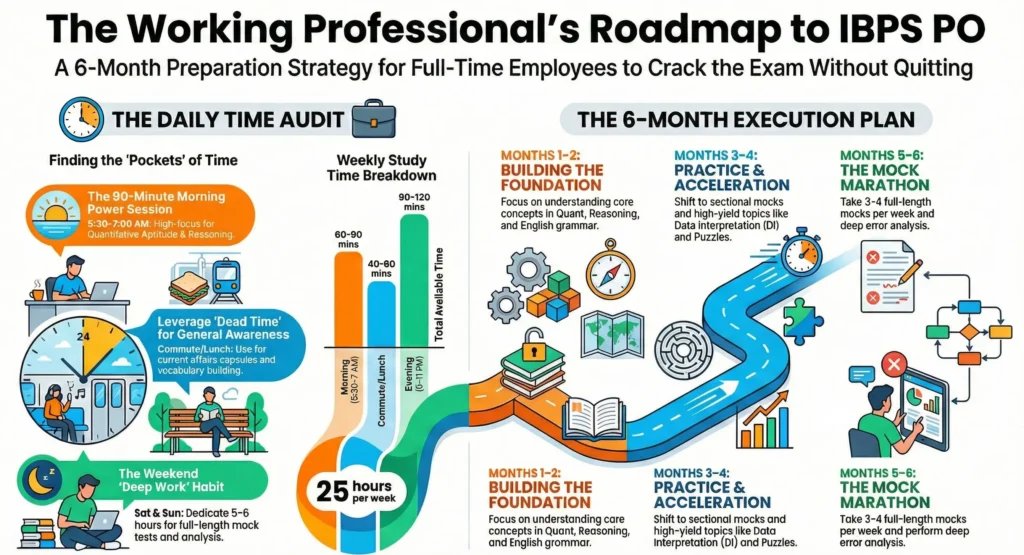
The honest answer: a minimum of 2–3 hours on weekdays and 5–6 hours on weekends, sustained consistently over 4–6 months. That adds up to roughly 500–700 hours of total preparation, which is considered adequate for a first or second attempt.
Let us break down a typical working professional’s day and identify pockets of study time:
| Time Slot | Available Minutes | Best Use |
| Morning (5:30–7:00 AM) | 60–90 mins | Quantitative Aptitude / Reasoning |
| Commute (one way) | 20–45 mins | Current Affairs / Banking Awareness |
| Lunch Break | 20–30 mins | Vocabulary / Reading comprehension |
| Evening (9:00–11:00 PM) | 90–120 mins | Mock tests / Mains subjects |
| Weekend mornings | 3–4 hours | Full-length mock tests & revision |
✅ Pro Tip: Download a banking exam app (like BYJU’s Exam Prep or Testbook) and keep it offline-ready so you can use commute time even without internet.
4. Building Your 6-Month IBPS PO Study Plan (Working Professional Edition)
A six-month timeline is ideal for working professionals. Here is how to divide it:
Phase 1: Foundation (Month 1–2)
The first two months are about building strong fundamentals across all sections. Do not attempt full-length mocks yet. Focus on understanding concepts.
- Quant: Number systems, simplification, percentages, ratio & proportion, average, profit & loss
- Reasoning: Seating arrangement, puzzles, syllogism, blood relations, coding-decoding
- English: Grammar rules, sentence correction, reading comprehension basics
- GA: Start reading The Hindu or Economic Times daily — just 20 minutes
Phase 2: Practice & Acceleration (Month 3–4)
Now that your fundamentals are in place, shift to section-wise practice tests. Take at least 2 sectional mocks per week. Start tracking your accuracy and time.
- Quant: Data Interpretation (DI) sets — the most scoring part of Mains
- Reasoning: Complex puzzles, blood relation coding, direction-based problems
- English: Cloze tests, para jumbles, reading comprehension passages
- GA: Start revising the last 6 months of current affairs + banking awareness capsules
Phase 3: Mocks & Revision (Month 5–6)
This is the most critical phase. Take at least 3–4 full-length mock tests per week, analyze them thoroughly, and revise weak areas. Do not attempt new topics in this phase.
- Prelims mock: 1 per day in the final 2 weeks before the exam
- Mains mock: 1 every 3 days once Prelims is cleared
- Descriptive writing: Practice 2 essays and 2 letters per week
- Interview prep: Read about banking sector news, your own work experience, and RBI policies
💡 Real Example: Aniket, an IT professional from Hyderabad, followed a 5-month plan while working 10-hour days. He scored 78/100 in Prelims and was selected in the final merit list. His secret? He gave 25+ full-length mocks in the last 6 weeks and analyzed each one for 45 minutes after completion.
5. Subject-Wise Strategy for Working Professionals
5.1 Quantitative Aptitude: Work Smarter, Not Harder
For working professionals, time is a premium. Do not waste it on low-yield topics. Prioritize chapters that give the highest return in both Prelims and Mains.
High-priority topics: Data Interpretation (DI), simplification, quadratic equations, number series, percentage-based problems.
Many aspirants spend weeks perfecting trigonometry or mensuration — topics that appear rarely and consume disproportionate prep time. Avoid this trap. A 70% score in quant is achievable with just 6–7 well-mastered topics.
✅ Pro Tip: Solve 15–20 DI questions every day without fail. DI accounts for 15–20 marks in Mains and is the single most impactful practice habit for this section.
5.2 Reasoning Ability: The Puzzle Grind
Reasoning is the most time-consuming section but also the most predictable. The same types of puzzles appear repeatedly — seating arrangements (linear and circular), blood relations, scheduling, floors and flats, and box puzzles.
Spend the first two months understanding the structure of each puzzle type. By month three, you should be able to identify the puzzle type within 30 seconds and decide whether to attempt it based on difficulty level — a crucial exam-day skill.
A useful trick many working aspirants use: spend 10 minutes every morning on a single puzzle from a previous year’s paper. It builds pattern recognition faster than any video lecture.
5.3 English Language: Your Silent Scoring Partner
Most engineers or science graduates underestimate English and most arts graduates overestimate it. The truth is, IBPS PO English is not just about grammar — it tests comprehension speed, vocabulary in context, and logical reading.
Daily reading is the most effective way to improve. Even 20 minutes of reading The Hindu editorial every morning improves both comprehension speed and vocabulary passively, over time.
For the Descriptive paper in Mains, practice structured writing. A letter or essay follows a fixed format. Once you master the structure, the only variable is content — which comes from your current affairs reading.
5.4 General/Economy/Banking Awareness: The Section Most Working Pros Ignore
This section is often the deciding factor in Mains cutoffs. And ironically, it is the one section where working professionals have a natural edge — particularly those already in the banking or finance sector.
Divide this section into two parts:
- Static banking awareness: Know your RBI, SEBI, NABARD, SIDBI, SBI history, governors, headquarters, and important regulations. This takes about 2 weeks to cover and rarely changes.
- Current affairs: Focus on the last 6 months before the exam. Banking-specific news, government schemes, RBI circulars, budget highlights, and important summits are the most frequently tested.
✅ Pro Tip: Subscribe to a good monthly current affairs PDF like GK Today or Bankersadda. Review it on weekends. Do not try to read daily long news articles — a structured digest is more efficient for working professionals.
6. A Sample Weekly Study Schedule for a Working Professional
Here is a practical sample schedule for someone working Monday to Friday with a 9-to-6 job. Adjust timings based on your shift and commute.
| Day | Morning (5:30–7 AM) | Evening (9–11 PM) | Weekend |
| Monday | Quant: DI practice (20 Q) | Reasoning: Puzzle sets | |
| Tuesday | English: RC passage + vocab | GA: Current affairs capsule | |
| Wednesday | Quant: Number series + simplification | Reasoning: Syllogism + coding | |
| Thursday | English: Grammar & error spotting | Quant: Mains DI sets | |
| Friday | GA: Banking awareness revision | English: Cloze test + para jumble | |
| Saturday | Full Prelims Mock (morning) + Analysis (2 hrs) | ||
| Sunday | Full Mains Mock or subject deep-dive + Descriptive writing practice |
This schedule accounts for approximately 2.5 hours on weekdays and 5–6 hours on weekends, totaling roughly 22–25 hours of prep per week. Over six months, that is close to 550–600 hours — sufficient for a well-planned attempt.
7. The Role of Mock Tests: The Single Most Important Habit
If you take only one piece of advice from this entire guide, let it be this: take mock tests regularly and analyze them deeply.
Working professionals who crack IBPS PO on their first or second attempt almost universally credit rigorous mock test practice. Here is why mock tests are so important specifically for working aspirants:
- They simulate exam conditions, helping you manage time pressure that you are less used to if your job does not involve timed cognitive tasks.
- They reveal your actual weak areas — not the ones you think are weak. Many aspirants spend months on quant when their actual bottleneck is slow reading comprehension.
- They build exam-day confidence. Walking into the exam having solved 30+ mocks in similar conditions fundamentally changes your psychological state.
The analysis phase is equally critical. After every mock, spend at least 30–45 minutes reviewing every wrong answer. Ask yourself: Was it a concept error? A calculation error? Or did I run out of time? Each category requires a different fix.
💡 Real Example: Meghna, a school teacher from Jaipur, solved only 35 mocks before her successful IBPS PO attempt. But she analyzed each one for nearly an hour. She says the analysis sessions taught her more than the actual mocks themselves.
8. Technology Tools That Give You an Edge
Working professionals cannot afford to waste time on inefficient study methods. Here are the tools and apps that genuinely help:
For Study & Practice
- Testbook / BYJU’s Exam Prep: Best for sectional and full-length mocks with detailed analytics
- Unacademy / Adda247: Live and recorded classes for concept building on the go
- Wren & Martin (app): Grammar reference and practice on mobile
For Current Affairs
- The Hindu App: Read 2–3 articles daily during lunch break
- Bankersadda Current Affairs PDF: Monthly download, review on weekends
- Inshorts: 60-word news summaries — quick reading during commute
For Time Management & Focus
- Forest App / Pomodoro Timer: Use 25-minute focus blocks for study sessions after work
- Google Calendar: Block study slots the same way you block work meetings — this psychological reframe works
- Notion / physical notebook: Maintain an error log for every mock test
✅ Pro Tip: Set your phone to Do Not Disturb during your evening study session. Research shows that a single notification interruption takes an average of 23 minutes to fully recover focus from. For a 2-hour window, that is devastating.
9. Handling Work Stress Without Letting It Kill Your Prep
This is the topic almost no exam prep blog talks about, yet it is the most real challenge for working aspirants.
There will be weeks where a project deadline or a difficult colleague or sheer fatigue makes studying feel impossible. Here is how to handle those phases without derailing your preparation:
The Minimum Viable Study Day
On days when you simply cannot study for two hours, define a minimum viable study session — 20 minutes of current affairs revision or solving 10 quant questions. It keeps the habit alive without demanding what you cannot give.
The Recovery Week
If you have had a particularly rough work month and missed a lot of prep, do not try to compensate by doubling your hours the next week. That leads to burnout. Instead, return to your baseline schedule and accept that the timeline may stretch by 2–3 weeks. That is fine.
Physical Health as a Non-Negotiable
Sleep deprivation is the silent killer of exam preparation. Many working aspirants sacrifice sleep to study — this backfires. Sleep is when the brain consolidates memory. A sleep-deprived brain retains less and performs worse on timed tests. Aim for at least 6.5–7 hours of sleep, even during intense preparation.
Aarav, a logistics manager from Delhi who cleared IBPS PO on his third attempt, credits his success to a counterintuitive decision: he stopped the habit of studying until midnight and instead woke up an hour earlier. The morning sessions, he says, were twice as productive as the late-night ones.
10. Preparing for the IBPS PO Interview: The Often-Neglected Final Round
Many working professionals focus almost entirely on Prelims and Mains preparation and then scramble to prepare for the interview in the 2–3 weeks between result and interview date. That is a mistake.
The interview carries 100 marks and is conducted by a panel from the Institute of Banking Personnel Selection along with representatives from member banks. It typically lasts 15–25 minutes and covers:
- Your academic and professional background
- Why you want to join a public sector bank when you are already employed
- Banking and economy awareness (especially recent RBI policies and government schemes)
- General awareness and situational questions
The question “Why do you want to leave your current job?” is almost always asked. Prepare an honest, confident answer that highlights your long-term vision without disparaging your current employer.
Being a working professional is actually a strong interview narrative. It shows that you have real-world experience, professional maturity, and that your choice to join banking is deliberate rather than a default fallback.
✅ Pro Tip: Keep a running list of important banking news, government schemes, and RBI policy changes from the 6 months before your expected interview. Review it weekly so that interview preparation is already happening during your Mains prep phase.
11. What to Do in the Final 30 Days Before the Exam
The last month is about refinement, not learning. Here is a day-by-day breakdown approach for the final phase:
- Week 1: Take one full Prelims mock every day. Analyze and revise weak topics only.
- Week 2: Continue mocks, but begin intensive current affairs revision. Cover the last 4 months.
- Week 3: Reduce mock frequency to alternate days. Focus on accuracy over speed. Revise formulas, shortcuts, and GA static notes.
- Week 4 (final week): No new topics. Light revision, stay positive, sleep well, and trust the preparation you have done.
One of the most common mistakes aspirants make in the last week is panic-studying topics they have never touched. This is counterproductive. The topics you have not studied are unlikely to provide significant marks; the topics you have studied well can be further strengthened with confidence.
Can I really clear IBPS PO while working full-time?
Yes — thousands of working professionals do it every year. The key is consistency, smart time management, and focusing on high-yield topics and mock test practice. It requires sacrifice, but it is very achievable.
How many months of preparation is enough for IBPS PO while working?
For most working professionals, 5–6 months of disciplined preparation is sufficient for the first serious attempt. Those who have studied in a previous attempt may need just 3–4 months to get back in form.
Should I take coaching or self-study?
Self-study with good quality online mock tests and video lectures is entirely sufficient and more flexible for working professionals. Paid coaching is optional but can be useful for structured guidance. Many successful working aspirants have cleared IBPS PO through purely self-directed study using apps like Testbook and YouTube channels.
What is the best time to study for someone working a 9-to-6 job?
Early mornings (5:30–7:00 AM) are typically the most productive for working aspirants — the mind is fresh, interruptions are minimal, and it sets a positive tone for the day. Evenings can be used for lighter tasks like current affairs or revision.
How do I stay motivated when preparation becomes difficult?
Remind yourself of your “why” — write it down and keep it visible. Break your preparation into small monthly milestones with rewards. Connect with other IBPS PO aspirants in online communities. And accept that motivation fluctuates — what matters is the system and habits you build, not how motivated you feel on any given day.
Conclusion: Your Job Is a Stepping Stone, Not a Roadblock
Preparing for IBPS PO while working full-time is hard. There is no point in pretending otherwise. You will have fewer hours, more fatigue, and more competing priorities than a full-time student. But you will also bring something they do not have — discipline forged by real-world experience, professional maturity, and a deeper understanding of why banking matters.
The strategy outlined in this guide is not theoretical. It is built on the real journeys of aspirants who have been exactly where you are — looking at their calendar, wondering if there is enough time. There is. It just requires you to use it deliberately.
Start with a honest self-assessment. Block your study hours in your calendar tonight. Take your first mock test this weekend. And remember: every hour you invest now is an hour building toward a future you have chosen.
You have already taken the first step by looking for a plan. Now it is time to execute it.
Best of luck with your IBPS PO preparation. You have got this.
Tags: IBPS PO preparation, how to prepare for IBPS PO while working full-time, IBPS PO study plan for working professionals, IBPS PO tips, bank exam preparation, government bank jobs, IBPS PO 2025