A Comprehensive Guide for Students and Professionals in Banking and Finance
In the competitive landscape of global finance, distinguishing yourself from thousands of equally ambitious professionals requires more than just a degree and work experience. It demands a commitment to excellence, continuous learning, and a credential that speaks volumes about your expertise. Enter the Chartered Financial Analyst (CFA) designation—widely regarded as the gold standard in investment management and financial analysis.
Whether you’re a finance student contemplating your career trajectory or a working professional seeking to accelerate your advancement, the CFA charter represents a transformative investment in your professional future. This comprehensive guide explores why pursuing the CFA designation could be the most strategic decision you make for your career in banking and finance.
Understanding the CFA Charter: More Than Just a Credential
The CFA charter is not merely another certification to add to your resume. Administered by the CFA Institute, this globally recognized designation represents the pinnacle of achievement in investment management and financial analysis. The program consists of three rigorous levels, each building upon the previous one, covering ethics, quantitative methods, economics, financial reporting, corporate finance, equity investments, fixed income, derivatives, alternative investments, and portfolio management.
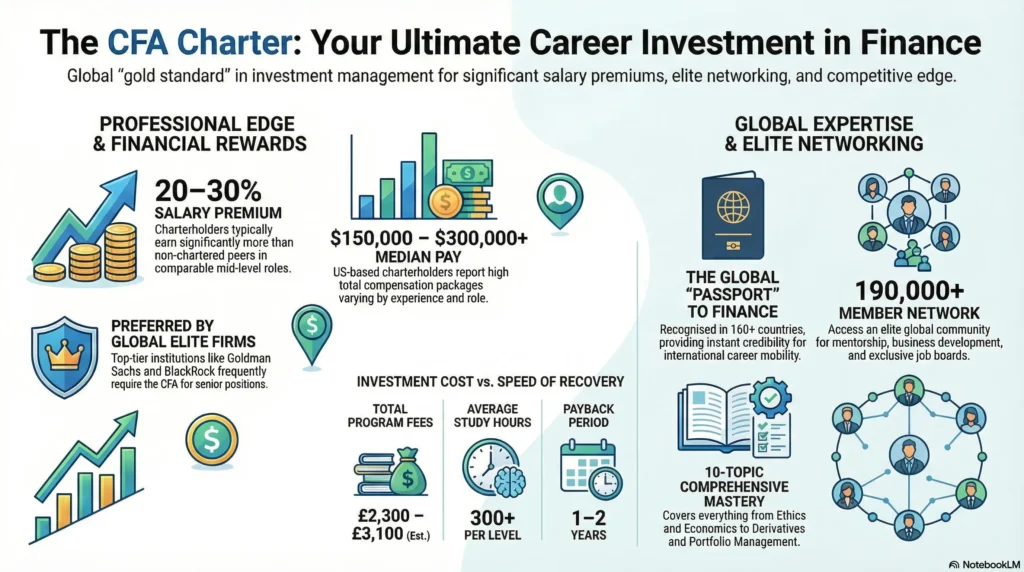
What sets the CFA apart is its comprehensive curriculum that evolves with industry practices, its stringent ethical standards, and its global recognition. With over 190,000 charterholders worldwide across 160+ countries, the CFA designation opens doors that remain firmly closed to others. The program’s pass rates—historically around 40-45% per level—ensure that earning the charter signifies genuine mastery of the material, not just attendance at a course.
Career Advancement: Opening Doors and Shattering Ceilings
Competitive Edge in a Crowded Market
In today’s finance industry, a bachelor’s degree is the baseline, and an MBA is increasingly common. The CFA charter, however, remains a differentiator. When competing for positions in investment banking, asset management, equity research, or wealth management, the CFA designation signals to employers that you possess not only theoretical knowledge but also practical skills and an unwavering commitment to professional excellence.
Many top-tier financial institutions actively seek CFA charterholders or candidates. Firms like Goldman Sachs, J.P. Morgan, BlackRock, Vanguard, and PIMCO frequently list the CFA as a preferred or required qualification for their analyst and portfolio manager positions. In competitive job markets, having the CFA after your name can be the deciding factor between landing an interview and being overlooked.
Vertical Mobility Within Your Organization
For working professionals, the CFA charter serves as a powerful catalyst for internal promotion. Many financial institutions have formal policies that recognize CFA charterholders with accelerated promotion tracks, higher compensation adjustments, and access to leadership development programs. The designation demonstrates initiative, intellectual capacity, and dedication—qualities that hiring managers and senior leaders value when considering promotions.
Moreover, the CFA curriculum’s emphasis on portfolio management and asset allocation prepares you for senior roles that require strategic thinking and decision-making authority. Whether you aspire to become a portfolio manager, chief investment officer, or head of research, the CFA provides the foundation and credibility necessary for these positions.
Financial Rewards: Quantifying the Return on Investment
Salary Premium and Earning Potential
While passion for finance should drive your career choices, the financial benefits of earning the CFA charter cannot be ignored. Multiple industry surveys consistently show that CFA charterholders command significantly higher salaries than their non-chartered peers. According to CFA Institute research, charterholders in the United States report median total compensation ranging from $150,000 to $300,000+, depending on experience level and role.
The salary premium becomes even more pronounced in senior positions. Portfolio managers with the CFA designation can earn base salaries exceeding $200,000, with total compensation packages reaching well into seven figures when bonuses and carried interest are included. Even in mid-level positions, CFA charterholders typically earn 20-30% more than comparable professionals without the designation.
Long-Term Wealth Accumulation
Beyond immediate salary increases, the CFA charter facilitates long-term wealth accumulation through enhanced career stability, better job opportunities during economic downturns, and access to performance-based compensation structures. Charterholders are less likely to experience extended unemployment periods and more likely to receive retention bonuses, equity compensation, and profit-sharing arrangements.
When you calculate the total career earnings differential over 30-40 years, the CFA charter’s return on investment becomes extraordinary. While the program requires significant time and money (approximately $3,000-$4,000 in registration and exam fees, plus study materials), this investment is recouped within 1-2 years through higher compensation and accelerated promotions.
Knowledge Depth: Becoming a True Investment Expert
Comprehensive Coverage of Financial Theory and Practice
The CFA curriculum is unparalleled in its breadth and depth. Unlike specialized degrees that focus narrowly on one aspect of finance, the CFA program ensures you develop expertise across the entire investment landscape. From understanding macroeconomic forces that drive markets to analyzing individual securities, from valuing complex derivatives to constructing optimal portfolios, the CFA equips you with a comprehensive toolkit.
This holistic understanding is invaluable in today’s interconnected financial markets. As an equity analyst, you’ll need to understand how fixed income yields affect stock valuations. As a portfolio manager, you’ll need to comprehend how alternative investments and derivatives can enhance risk-adjusted returns. The CFA curriculum ensures you’re never operating with knowledge gaps that could compromise your decision-making.
Practical Application and Real-World Relevance
Unlike purely academic programs, the CFA curriculum emphasizes practical application. The program is designed by investment professionals for investment professionals, ensuring that every concept you learn has direct relevance to your daily work. Case studies, item sets, and constructed response questions force you to apply theoretical knowledge to real-world scenarios, developing the critical thinking skills that employers value.
This practical orientation means you’ll immediately notice improvements in your job performance as you progress through the program. Many candidates report that studying for the CFA directly enhances their ability to analyze investments, understand market dynamics, and communicate complex financial concepts to clients and colleagues.
Global Recognition and Mobility
A Passport to International Opportunities
In an increasingly globalized financial industry, the ability to work across borders is invaluable. The CFA charter is recognized and respected in every major financial center worldwide—from New York and London to Hong Kong, Singapore, and Dubai. This universal recognition means that your credential travels with you, opening opportunities regardless of geography.
For professionals interested in international careers, the CFA provides instant credibility. Many multinational financial institutions prefer candidates with the CFA designation because it represents a standardized level of knowledge and ethical standards, eliminating concerns about varying educational quality across different countries. Whether you’re seeking to transfer within your firm’s global network or pursuing opportunities with international organizations, the CFA charter facilitates these moves.
Common Language and Standards
The CFA program creates a common professional language among charterholders worldwide. When you’re working with colleagues, clients, or counterparties who also hold the charter, you share a foundation of knowledge and ethical principles that facilitates communication and trust. This common ground proves especially valuable in cross-border transactions and international investment teams where misunderstandings can be costly.
Ethics and Professional Conduct: The Foundation of Trust
Commitment to the Highest Ethical Standards
In the wake of financial scandals and market crises, the importance of ethical conduct in finance cannot be overstated. The CFA Program places extraordinary emphasis on ethics, dedicating significant curriculum time to the Code of Ethics and Standards of Professional Conduct. Ethics questions appear throughout all three exam levels, and candidates must demonstrate mastery of ethical principles to pass.
This ethical foundation sets CFA charterholders apart. Clients, employers, and regulators trust charterholders to put client interests first, maintain confidentiality, provide objective analysis, and operate with integrity. In client-facing roles, this reputation for ethical conduct can be a decisive competitive advantage. Many high-net-worth individuals and institutional investors specifically seek advisors with the CFA designation because of its ethical requirements.
Continuing Ethics Education and Accountability
The ethical commitment doesn’t end with earning the charter. CFA charterholders must comply with ongoing Professional Conduct Statement requirements, adhere to the Code and Standards throughout their careers, and can face disciplinary action for violations. This accountability framework ensures that the CFA designation maintains its reputation for integrity, further enhancing its value to holders.
Networking and Professional Community
Access to a Global Network of Elite Professionals
The CFA community represents one of the most valuable professional networks in finance. With 190,000+ charterholders and nearly 300,000 candidates worldwide, you gain access to a network that spans every sector of the financial industry and every geographic market. This network provides opportunities for mentorship, business development, knowledge sharing, and career advancement that would be difficult to access otherwise.
CFA Institute local societies organize regular events, continuing education programs, and networking opportunities in over 160 locations worldwide. These gatherings bring together investment professionals at all career stages, creating opportunities to learn from experienced practitioners, connect with potential employers, and build relationships that can prove invaluable throughout your career.
Career Resources and Support
Beyond networking events, the CFA community provides extensive career resources. Job boards featuring positions specifically seeking CFA charterholders, career counseling services, salary surveys and market intelligence, and mentorship programs connect you with resources designed to support your professional growth. Many charterholders credit these resources with helping them navigate career transitions, negotiate compensation packages, and identify opportunities they wouldn’t have found otherwise.
Specialized Knowledge for Different Career Paths
Investment Banking and Corporate Finance
For professionals in investment banking, the CFA curriculum provides deep expertise in valuation methodologies, financial modeling, and capital structure analysis. The program’s coverage of mergers and acquisitions, leveraged buyouts, and corporate restructuring directly supports the work of investment bankers. Many investment banks value the CFA alongside or even above an MBA, particularly for roles in coverage groups and product teams.
Equity Research and Analysis
Equity research analysts find the CFA particularly valuable, as the curriculum’s extensive coverage of financial statement analysis, industry analysis, and equity valuation directly translates to their daily work. The program teaches you to dissect financial statements, identify value drivers, build forecasting models, and communicate investment recommendations—precisely the skills required for success in equity research.
Portfolio and Asset Management
For those pursuing careers in portfolio management, the CFA is virtually essential. The program’s comprehensive coverage of portfolio theory, asset allocation, risk management, and performance measurement provides the foundation necessary for managing client assets. Many asset management firms require or strongly prefer the CFA designation for portfolio manager positions, recognizing that the program specifically develops the skills needed for investment decision-making.
Wealth Management and Private Banking
Wealth managers and private bankers benefit from the CFA’s emphasis on client relationships, ethical conduct, and comprehensive financial planning. The designation enhances credibility with high-net-worth clients who seek advisors with proven expertise. Additionally, the program’s coverage of behavioral finance helps wealth managers understand and manage client psychology during market volatility.
Overcoming the Challenges: Why the Difficulty Enhances the Value
The Rigor That Creates Respect
There’s no denying that the CFA program is demanding. With average study times of 300+ hours per level and pass rates typically below 50%, earning the charter requires genuine commitment and sacrifice. However, this difficulty is precisely what makes the designation valuable. The CFA charter signals to employers and clients that you have the discipline, intelligence, and determination to complete one of the most challenging professional programs in finance.
The rigor serves another important purpose: it ensures that charterholders genuinely master the material rather than simply memorizing facts for an exam. The challenging item sets and constructed response questions force you to apply knowledge, analyze complex situations, and develop reasoned judgments—skills that transfer directly to professional practice.
Time Management and Personal Growth
Successfully completing the CFA program while working full-time requires exceptional time management, discipline, and prioritization—skills that prove invaluable throughout your career. Many charterholders report that the personal growth they experienced during the program—learning to balance competing demands, maintain focus on long-term goals, and persevere through challenges—proved as valuable as the technical knowledge they gained.
Strategic Timing: When to Pursue the CFA
For Students: Starting Your Career with a Competitive Edge
If you’re currently a student or recent graduate, beginning the CFA program early offers significant advantages. You can leverage your study skills and available time to progress through the exams more quickly. Many successful candidates complete all three levels within 2-3 years when starting as students, entering the workforce as CFA charterholders and immediately commanding higher starting salaries and better position offers.
Starting early also means you can choose roles and opportunities aligned with your investment management aspirations from day one. Instead of spending years in positions that don’t fully utilize your capabilities, you can target roles that offer meaningful experience toward the work experience requirement for the charter.
For Working Professionals: Accelerating Career Progression
Working professionals should consider pursuing the CFA when they’ve identified clear career goals that align with the designation’s benefits. If you’re seeking to transition into portfolio management, equity research, or senior analytical roles, the CFA provides both the knowledge and credibility to make that move. The program’s practical orientation means you can immediately apply what you’re learning to your current role, often improving your performance even before earning the charter.
For professionals who feel their career has plateaued or who are seeking to differentiate themselves in competitive promotion cycles, the CFA can provide the catalyst needed for breakthrough. Many professionals report that announcing their candidacy and demonstrating commitment to the program signaled to management that they were serious about advancement, often leading to increased responsibilities even before completing all three levels.
Complementing Your Existing Credentials
The CFA charter complements rather than replaces other educational credentials. An MBA from a top business school combined with the CFA designation is particularly powerful, merging general management knowledge with deep investment expertise. Similarly, combining the CFA with specialized certifications like the FRM (Financial Risk Manager) or CAIA (Chartered Alternative Investment Analyst) creates a comprehensive skill set that commands premium compensation.
For those with technical undergraduate degrees in engineering, mathematics, or computer science, the CFA provides the finance foundation necessary to transition into quantitative finance roles. The program’s coverage of quantitative methods, statistics, and financial theory bridges the gap between technical expertise and investment application.
The Future of Finance and the CFA Advantage
As the financial industry evolves with technological advancement, regulatory changes, and shifting investor preferences, the need for well-trained, ethical investment professionals only increases. Robo-advisors and algorithmic trading may automate certain aspects of investment management, but they cannot replace the judgment, creativity, and ethical reasoning that characterize successful investment professionals.
The CFA curriculum continuously evolves to address emerging topics like fintech, sustainable investing, artificial intelligence in portfolio management, and cryptocurrency. This ensures that charterholders remain at the forefront of industry developments, equipped to navigate whatever changes the future brings. In an industry increasingly concerned with ESG factors, behavioral finance, and complex alternative investments, the comprehensive knowledge provided by the CFA program becomes ever more valuable.
Real-World Success Stories: The CFA Impact in Action
The true value of the CFA charter is best illustrated through the experiences of those who’ve earned it. Consider the career trajectory of professionals who entered the finance industry without the designation and later pursued it. Many report that earning the charter represented a turning point—suddenly doors that were previously closed began opening, opportunities that seemed out of reach became attainable.
Financial analysts who struggled to move beyond junior positions found themselves promoted to senior analyst or associate portfolio manager roles after earning the charter. Private bankers who competed for high-net-worth clients discovered that the CFA designation provided the credibility differential that helped them win competitive mandates. Investment bankers who sought to transition into buy-side roles found that the charter facilitated these moves by demonstrating commitment to investment management.
Perhaps most compelling are the stories of career changers—professionals from other industries who used the CFA program to successfully transition into finance. Engineers, accountants, lawyers, and even military officers have leveraged the charter to enter investment roles that would have been difficult to access otherwise. The standardized knowledge and ethical foundation provided by the program gave these career switchers credibility despite lacking traditional finance backgrounds.
Practical Strategies for CFA Success
Creating a Sustainable Study Plan
Success in the CFA program requires strategic planning and disciplined execution. Begin by creating a realistic study schedule that accounts for your work commitments, personal obligations, and need for rest. Most successful candidates allocate 15-20 hours per week over 6 months for each level, though your required time may vary based on your background and learning style.
Start with the most challenging topics when your energy is highest. For many candidates, quantitative methods, derivatives, and fixed income prove most difficult, so tackling these subjects early allows time for multiple reviews. Build regular review sessions into your schedule, as retention improves with spaced repetition. Create a comprehensive set of notes or flashcards for efficient review in the final weeks before the exam.
Balancing Work, Study, and Life
Working professionals pursuing the CFA must master the art of balance. Communicate your commitment to family and friends, enlisting their support for your study period. Consider negotiating reduced work responsibilities during the final month before exams if possible. Many employers, particularly in finance, understand the value of the CFA and may accommodate reasonable requests for flexibility.
Maintain your physical and mental health throughout the journey. Regular exercise, adequate sleep, and healthy eating habits improve both learning efficiency and stress management. Burnout helps no one—candidates who push too hard often experience diminishing returns as fatigue impairs concentration and retention. Build rest days into your schedule and take them seriously.
Leveraging Study Groups and Resources
While the CFA is ultimately an individual achievement, study groups can enhance your preparation. Fellow candidates provide accountability, clarify difficult concepts through discussion, and offer moral support during challenging periods. Local CFA societies often facilitate study group formation, connecting candidates in your geographic area or industry.
Invest in quality study materials. While the CFA Institute curriculum provides comprehensive coverage, many candidates find that third-party providers’ structured study notes, question banks, and mock exams enhance their preparation. Popular providers include Kaplan Schweser, CFA Institute’s own prep materials, and various online platforms. Choose resources that match your learning style—some candidates prefer detailed notes, others benefit more from video lectures or intensive review courses.
Addressing Common Concerns and Misconceptions
Is the CFA Worth It Without an MBA?
Absolutely. While an MBA offers broad business education and networking opportunities, the CFA provides deeper, more specialized knowledge in investment management. Many successful investment professionals hold the CFA without an MBA, particularly those in equity research, portfolio management, and financial analysis roles where technical expertise matters more than general management skills. The CFA’s lower cost and ability to complete it while working make it an attractive alternative or complement to an MBA.
What If I Fail an Exam?
Many ultimately successful charterholders failed at least one exam level. The program’s difficulty means that even well-prepared, intelligent candidates sometimes come up short. Failure, while disappointing, provides valuable feedback about your knowledge gaps and study approach. Candidates who fail typically identify specific weaknesses—perhaps inadequate practice with item sets, insufficient review time, or gaps in conceptual understanding—and address these in their next attempt.
The key is persistence. The CFA Institute imposes no limit on exam attempts, and many charterholders required multiple attempts at one or more levels. Your commitment to continuing despite setbacks actually demonstrates the resilience and determination that make the charter valuable. Employers and clients respect candidates who persevere through challenges to ultimately achieve their goals.
Can I Succeed with a Non-Finance Background?
Yes, though you may need to invest additional time in foundational concepts. The CFA curriculum assumes limited prior knowledge, building from fundamentals. Candidates with engineering, mathematics, or science backgrounds often excel in quantitative sections while needing extra work on accounting and economics. Those with liberal arts educations may find ethics and behavioral finance intuitive while requiring more effort in quantitative methods.
Your diverse background can actually prove advantageous. The finance industry increasingly values professionals who bring different perspectives and analytical frameworks. A psychologist’s understanding of human behavior, an engineer’s systematic thinking, or a lawyer’s attention to detail can enhance investment analysis in ways that pure finance training might not. The CFA program provides the technical foundation while your unique background adds differentiated value.
Conclusion: Making the Decision That Defines Your Career
Pursuing the CFA charter represents a significant commitment of time, money, and effort. The program is intentionally challenging, requiring hundreds of hours of study and genuine mastery of complex material. However, for students and professionals serious about building exceptional careers in banking and finance, the CFA designation offers unparalleled benefits.
The tangible advantages—higher compensation, better job opportunities, accelerated promotions—make a compelling case for the program’s ROI. But the intangible benefits may prove even more valuable: the deep expertise that makes you truly excellent at your work, the ethical foundation that builds trust with clients and colleagues, the global network that supports you throughout your career, and the personal satisfaction of achieving one of finance’s most prestigious credentials.
Whether you’re a finance student beginning your career or a working professional seeking the next level of success, the CFA charter offers a clear pathway to distinction in a competitive industry. The designation won’t guarantee success—your work ethic, interpersonal skills, and strategic career decisions remain crucial—but it provides the foundation, credibility, and competitive edge that separate ordinary careers from extraordinary ones.
In the end, the question isn’t whether the CFA charter is valuable—the evidence overwhelmingly confirms that it is. The question is whether you’re ready to make the commitment necessary to earn it. For those who are, the rewards—professional, financial, and personal—will compound throughout your career, making the CFA charter one of the best investments you’ll ever make in yourself.
The journey to becoming a CFA charterholder is challenging, but it’s a challenge that transforms you into a more capable, knowledgeable, and respected investment professional. And in the competitive world of finance, that transformation can make all the difference.